

Last Tuesday, you found your mother standing in her Santa Rosa kitchen, holding a kettle she forgot how to use, her eyes filled with a quiet, heartbreaking confusion. It’s a moment many of the 1.4 million family caregivers in California know well, where the person who once anchored your world now seems to be drifting away. You’ve likely spent months wondering if these lapses are just normal aging or the specific signs my parent needs memory care. It’s exhausting to carry the weight of their safety while managing your own life, and the guilt of even considering a change can feel heavy on your heart.
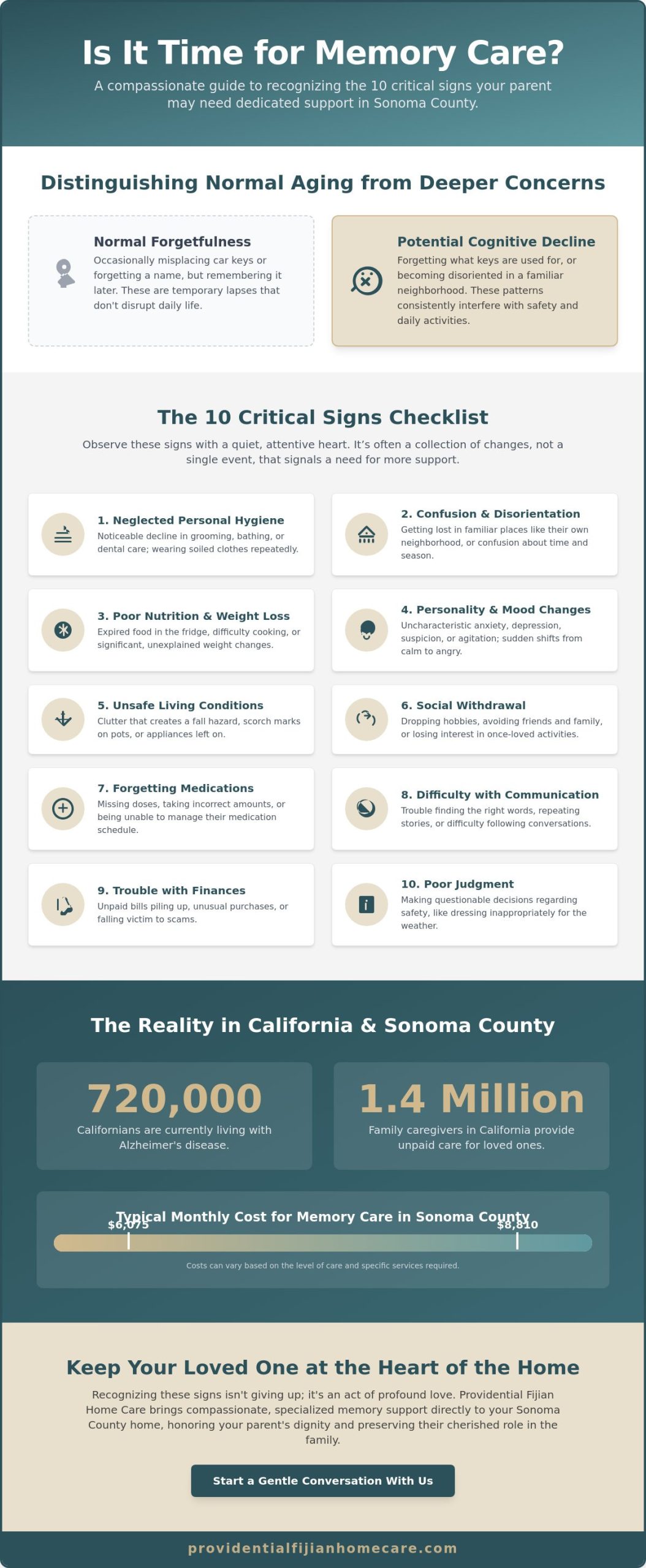
We believe that caring for our elders is a sacred privilege, as they remain the heart of the home even when their memories fade. This guide offers a clear way to measure if professional help is needed, validating that seeking support is an act of profound love rather than a loss of duty. You’ll discover ten behavioral and physical red flags, along with an overview of Sonoma County options where costs typically range from $6,075 to $8,810 per month. We’ll also highlight local pillars of support like the Redwood Caregiver Resource Center to help your family feel safe, seen, and truly cherished.
Key Takeaways
- Learn to distinguish between normal senior moments and the threshold of cognitive impairment that requires a more nurturing level of support.
- Use our comprehensive checklist to identify the physical and behavioral signs my parent needs memory care, focusing on their ability to manage daily activities with dignity.
- Understand how to resolve the “Safety vs. Independence” paradox to ensure your loved one remains safe and truly cherished in their Sonoma County home.
- Discover the essential first steps for navigating a dementia diagnosis in the North Bay, including how to lead heartfelt family conversations with grace.
- Explore how the Fijian tradition of honoring the “heart of the home” offers a compassionate, in-home alternative to traditional memory care facilities.
Distinguishing Normal Aging from Memory Care Needs in Santa Rosa
In our Fijian tradition, the elderly are the “heart of the home.” They’re the keepers of our stories and the foundation of our strength. Seeing a parent struggle with memory isn’t just a clinical observation; it’s a deeply personal shift that touches every member of the family. While we all experience occasional forgetfulness as we age, there’s a specific threshold where simple “senior moments” transition into something that requires a more specialized approach to safety. Recognizing the signs my parent needs memory care is often the first step in honoring their dignity while ensuring they remain safe, seen, and truly cherished.
In Sonoma County, our daily rhythms are often tied to familiar local landmarks. When a parent who has lived in Santa Rosa for thirty years suddenly finds the drive to the Montgomery Village post office or a routine grocery trip in Petaluma overwhelming, it’s often more than just stress. Memory care isn’t just “extra help” with chores. It’s a focused, intentional way of providing environment-based support that protects a loved one from the confusion and physical risks that come with cognitive changes. This level of support ensures that even as their needs evolve, their place as the center of the family remains respected and secure.
Normal Forgetfulness vs. Cognitive Decline
Misplacing your car keys is a common part of a busy life. However, forgetting what those keys are used for, or finding them in the freezer, indicates a different level of concern. For families in the North Bay, this often manifests as a loss of “wayfinding.” If your loved one becomes disoriented while walking through their own neighborhood in Rincon Valley or forgets how to navigate the familiar aisles of their local market, these are significant indicators. Understanding Dementia involves recognizing that these patterns aren’t choices, but neurological shifts that require professional compassion. Cognitive decline is a persistent interference with daily life, not a temporary lapse.
The Emotional Weight of Recognition
It’s natural for families in Windsor and Healdsburg to feel a sense of fear or even denial when these changes occur. You might worry that acknowledging the need for help feels like giving up on your parent. We invite you to view dementia care in Sonoma County as a tool for preservation, not abandonment. By stepping into the role of the “Wise Nurturer,” you aren’t moving them away from the family; you’re bringing in the support necessary to keep them at the center of it. With an estimated 720,000 Californians currently living with Alzheimer’s, you aren’t alone in this journey. Identifying the signs my parent needs memory care is an act of profound love that allows your parent to live with the respect they’ve earned throughout their life.
The 10 Critical Signs My Parent Needs Memory Care Checklist
Observing the signs my parent needs memory care requires a quiet, attentive heart. It’s rarely about a single incident; instead, it’s a slow gathering of changes that suggest your loved one is no longer safe navigating their world alone. In our Fijian culture, we view our elders as the soul of the family, and protecting that soul means being brave enough to see when they can no longer protect themselves. The National Institute on Aging recommends looking for specific signs an older adult needs help, particularly when those signs involve the essential Activities of Daily Living (ADLs) that keep a person healthy and dignified.
When you visit your parent’s home in Santa Rosa or Petaluma, look beyond the surface. Is the person who once took immense pride in their garden now letting the weeds take over? Is the kitchen, once the site of warm family meals, now filled with expired food or cluttered with unopened mail? These environmental cues are often the first whispers that a change is needed. If you’re feeling overwhelmed by these discoveries, we invite you to start a gentle conversation with us about how we can support your family through this transition.
Physical and Self-Care Red Flags
- Noticeable Weight Loss: You might see your parent looking thinner or notice their clothes fitting loosely. This often happens because they simply forget to eat or find the process of cooking too confusing to manage safely.
- Decline in Personal Hygiene: A cherished parent who was always well-groomed may begin wearing the same clothes for several days or neglect bathing and hair care.
- Unexplained Bruises: With 1.4 million family caregivers in California providing billions of hours of care, many are familiar with the fear of falls. Bruises on the arms or hips can indicate balance issues or “near-miss” falls that your parent may not remember or want to report.
Behavioral and Cognitive Warning Signs
Wandering and Social Withdrawal
One of the most high-risk triggers is wandering. Your parent might set out for a familiar walk to the Santa Rosa Plaza or a local park but suddenly find the route unrecognizable. This “wayfinding” failure is a clear signal that specialized support is necessary. Furthermore, keep a close watch for social withdrawal. If your mother or father stops attending community events in Sonoma County or loses interest in hobbies they once loved, they may be retreating because social interaction has become too cognitively taxing. You may also notice increased agitation or “sundowning,” where confusion and anxiety peak in the late afternoon as the sun begins to set over the North Bay hills.
Medication mismanagement is perhaps the most critical safety risk. If you find pill organizers that are either untouched or double-dosed, it’s a definitive sign that your parent needs a higher level of oversight. In California, where 720,000 seniors are living with Alzheimer’s as of 2025, ensuring proper medication intake is a vital part of honoring their health and longevity. These patterns are the signs my parent needs memory care that demand an honorable, compassionate response to keep them safe and truly cherished.
Evaluating Safety and Quality of Life at Home in Sonoma County
Choosing between a parent’s independence and their physical safety is perhaps the most difficult paradox a family will ever face. You want to honor their desire to remain in the home where they raised you, yet you can’t shake the worry that accompanies every phone call that goes unanswered. This tension is where many families first begin searching for the signs my parent needs memory care. It’s important to remember that the “heart of the home” isn’t just a structure; it’s the feeling of being safe, seen, and truly cherished. When the home environment starts to pose more risks than comfort, the most honorable choice is to bring in a higher level of protection.
Many adult children in our community carry the heavy weight of a promise made years ago to “never move” a parent. If you’re feeling this guilt, try to reframe that commitment. Your true promise was to provide the highest quality of life and unconditional love. Sometimes, fulfilling that promise requires admitting that staying home without professional in-home help for seniors is no longer an act of love, but a gamble with their well-being. For those not yet ready for a permanent change, respite care can serve as a gentle middle ground, allowing family caregivers to rest while ensuring their loved one receives expert attention.
When is Home No Longer Safe?
A home that was once a sanctuary can quickly become a maze of hazards for someone with cognitive decline. We often see families discover stoves left on for hours, or find refrigerators filled with expired food that poses a serious risk of illness. Beyond the kitchen, wandering is a significant concern in our busier Santa Rosa neighborhoods. A parent might wander into high-traffic areas or become lost during a sudden North Bay rainstorm, unable to recall their way back. Professional home care givers act as vigilant guardians, mitigating these hazards by providing constant, compassionate supervision that preserves the dignity of the senior while removing the immediate danger.
The Toll on the Family Caregiver
With roughly 1.4 million family caregivers in California providing 1.8 billion hours of unpaid support, the risk of burnout is incredibly high. If you find yourself constantly irritable, suffering from new health issues, or feeling socially isolated, your own well-being is at a breaking point. A burnt-out caregiver, despite their best intentions, can become a safety risk for the parent because extreme exhaustion leads to missed cues or slower reaction times. Reframing professional support allows you to step back from the exhausting role of a 24-hour nurse. It lets you return to being the son or daughter again, focusing on meaningful connections while experts handle the complexities of memory support. This shift isn’t about stepping away; it’s about stepping into a more sustainable way to love your parent as their needs grow.
Next Steps: Navigating a Dementia Diagnosis in the North Bay
Once you’ve recognized the signs my parent needs memory care, the path forward can feel overwhelming. It’s a journey that requires both practical action and emotional grace. In our Fijian tradition, we believe that when a family member faces a challenge, the entire community rises to support them. Navigating a diagnosis isn’t something you have to do alone. By taking structured steps within our Sonoma County healthcare system, you can move from a place of worry to a position of prepared, loving advocacy for the person who remains the heart of your home.
Your first priority is securing a professional medical evaluation. We recommend scheduling a comprehensive geriatric assessment with local specialists at Kaiser Santa Rosa or Sutter Health. Before the appointment, document specific incidents you’ve observed from your checklist, such as missed medications or disorientation during trips to the grocery store. This evidence helps physicians distinguish between temporary health issues and long-term cognitive changes. While you wait for medical clarity, it’s also wise to research local caregiver agencies that specialize in memory support. Having these resources ready allows you to respond with calm and confidence when the time for action arrives.
Legal and financial preparations are equally vital during this early stage. Reviewing Power of Attorney documents, living trusts, and healthcare directives while your parent can still actively participate in the conversation is an act of profound respect. It ensures their wishes are honored even as their memory fades. If you’re feeling uncertain about how to begin this process, we invite you to reach out for a supportive conversation about your family’s unique needs.
Starting the Conversation with Your Parent
Approaching a parent about their memory can feel like walking on eggshells. To keep the dialogue nurturing, use “I” statements to express your feelings rather than “You” statements that might trigger defensiveness. Instead of saying, “You’re getting lost,” try a softer approach: “Mom, I’ve been feeling worried about your safety lately, and I want to make sure you have the support you need so you can stay in this home you love.” This framing keeps the focus on keeping them safe, seen, and truly cherished in their familiar surroundings.
Local Resources and Support Groups
Sonoma County offers a wealth of community support designed to help families stay resilient. The Sonoma County Area Agency on Aging provides essential guidance on local services and elder rights. For emotional support, look into local dementia support groups in Petaluma and Santa Rosa, where you can connect with others walking a similar path. These communities remind us that while the journey is difficult, there is strength in shared experience. Specialized memory care plays a beautiful role in these transitions, helping your loved one maintain their dignity and spirit throughout every stage of their life.
How Providential Fijian Home Care Supports Santa Rosa Families
When you recognize the signs my parent needs memory care, your first instinct might be to research residential facilities. However, we believe that the most profound comfort and healing occur in the place your loved one knows best. At Providential Fijian Home Care, we offer a unique approach rooted in our heritage, which we call “Care That Feels Like Family.” In our culture, caring for the elderly is an honorable service, a privilege that allows us to treat your parent as the true heart of the home. By bringing specialized support directly to them, we ensure they remain in their cherished surroundings while receiving the expert attention their condition requires.
Our philosophy is built on the belief that every senior deserves to feel safe, seen, and truly cherished. For a parent living with dementia, the world can become a place of frightening shadows and confusing noises. A clinical or transactional approach to care can often worsen their agitation. Our caregivers bring a deep, cultural warmth and a patient spirit that helps de-escalate the anxiety often associated with memory loss. This atmosphere of unconditional love creates a sense of deep respect, transforming daily tasks into meaningful connections that honor the individual’s history and dignity.
Specialized Memory Support at Home
Providing memory care at home requires more than just a watchful eye; it demands a structured, rhythmic approach to daily life. Our caregivers are specifically trained to manage the complexities of sundowning and wandering by creating a calming environment as the day fades. By maintaining a consistent routine and encouraging cognitive engagement through familiar activities, we help slow the progression of confusion. This specialized support bridges the gap between the efforts of family members and the technical requirements of professional home care in Santa Rosa. We take the heavy burden of “nursing” off your shoulders so you can focus on the love that defines your relationship.
Our Commitment to the Sonoma County Community
Since 2016, we’ve served as a local, family-run pillar of the Santa Rosa community, providing a level of care that transcends standard industry practices. We embrace the role of the “Wise Nurturer,” combining high-level skill with an intensely loyal dedication to the families we serve. We don’t see your parent as a client; we see them as a cherished elder who deserves honorable service. If you’ve started noticing the signs my parent needs memory care, please know that you don’t have to navigate this transition alone. We invite you to start a conversation with us today for a free, heartfelt assessment of your needs. Let us help you keep your loved one safe, seen, and truly cherished in the home they love.
Honoring Your Parent’s Journey with Grace
Stepping into the role of a caregiver is one of the most profound ways to honor the person who once anchored your world. By learning to identify the specific signs my parent needs memory care, you’ve already taken a vital step toward protecting their dignity. You now recognize that specialized support isn’t about taking away their independence; it’s about providing the safety they need to remain the heart of the home. This transition is naturally emotional, but you now have the tools to move forward with clarity and peace.
Since 2016, our family-run team has served Sonoma County with specialized Alzheimer’s and dementia training that prioritizes the person over the diagnosis. Our work is rooted in traditional Fijian values of reverence and unconditional respect, ensuring every senior feels safe, seen, and truly cherished. We invite you to start a compassionate conversation with our Santa Rosa team today to explore how we can support your family’s unique path. You don’t have to carry this weight alone. Choosing professional support is a beautiful act of love that preserves your parent’s legacy for years to come.
Frequently Asked Questions
How do I know if my parent is just being stubborn or if they have dementia?
Distinguishing between personality and pathology is essential for your peace of mind. Stubbornness is a choice to resist, but dementia is a neurological inability to process information or remember sequence steps. If your loved one is forgetting how to perform tasks they’ve done for decades, these are the signs my parent needs memory care rather than just a difficult mood or a strong-willed personality.
Is it safe for someone with dementia to live alone in Santa Rosa?
Safety risks often make living alone untenable as cognitive decline progresses. Risks such as forgetting to turn off a kitchen stove or wandering into busy Santa Rosa traffic are significant concerns. With 1.4 million family caregivers in California providing billions of unpaid hours, the data shows that consistent supervision is often necessary to keep a senior safe, seen, and truly cherished.
What is the difference between assisted living and in-home memory care?
Assisted living requires moving to a facility, while in-home memory care brings professional support to your parent’s familiar environment. This specialized approach allows them to remain the “heart of the home” while receiving expert help. In-home care focuses on maintaining routines in a place filled with their own memories, which often reduces the agitation and confusion frequently seen in facility settings.
Can I get help with dementia care costs in Sonoma County?
Families can find guidance through the Sonoma County Area Agency on Aging and the Redwood Caregiver Resource Center. A new law, SB950, takes effect on January 1, 2027, mandating that health insurance plans cover medically necessary Alzheimer’s treatments. For home care specifically, long-term care insurance or Veterans Aid and Attendance benefits are common ways local families manage these essential costs.
What should I do if my parent refuses to accept help?
Start by validating their feelings and framing professional support as a way to preserve their independence at home. Use gentle “I” statements to express your concern for their safety. It’s often helpful to introduce a caregiver as a “companion” or “household assistant” initially, allowing the relationship to grow naturally through cultural warmth and a shared sense of respect.
Does Medicare cover memory care services in California?
Medicare typically does not cover the “custodial care” involved in memory support, such as help with bathing, dressing, or meal preparation. It covers medical appointments, hospice, and short-term skilled nursing. Most California families utilize private funds or long-term care insurance to cover the person-centered care and dementia training requirements mandated by the 2025 California RCFE regulations.
How can a Fijian caregiver help my parent with Alzheimer’s specifically?
Our caregivers view the elderly with a reverent “Wise Nurturer” perspective, treating every senior as if they were their own kin. This cultural warmth is especially effective for those with Alzheimer’s who may feel easily frightened or confused. By following our “Care That Feels Like Family” mission, we use patience and heartfelt dedication to de-escalate agitation and create a peaceful, stable atmosphere.
What are the first steps to take after a dementia diagnosis in Santa Rosa?
Your first priority is a geriatric assessment at a local provider like Kaiser Santa Rosa or Sutter Health. Following this, contact the Alzheimer’s Association 24/7 Helpline at 800-272-3900 for immediate local resources. Documenting the signs my parent needs memory care from our checklist will help you provide clear, actionable information to your medical team and local caregiver agencies.