
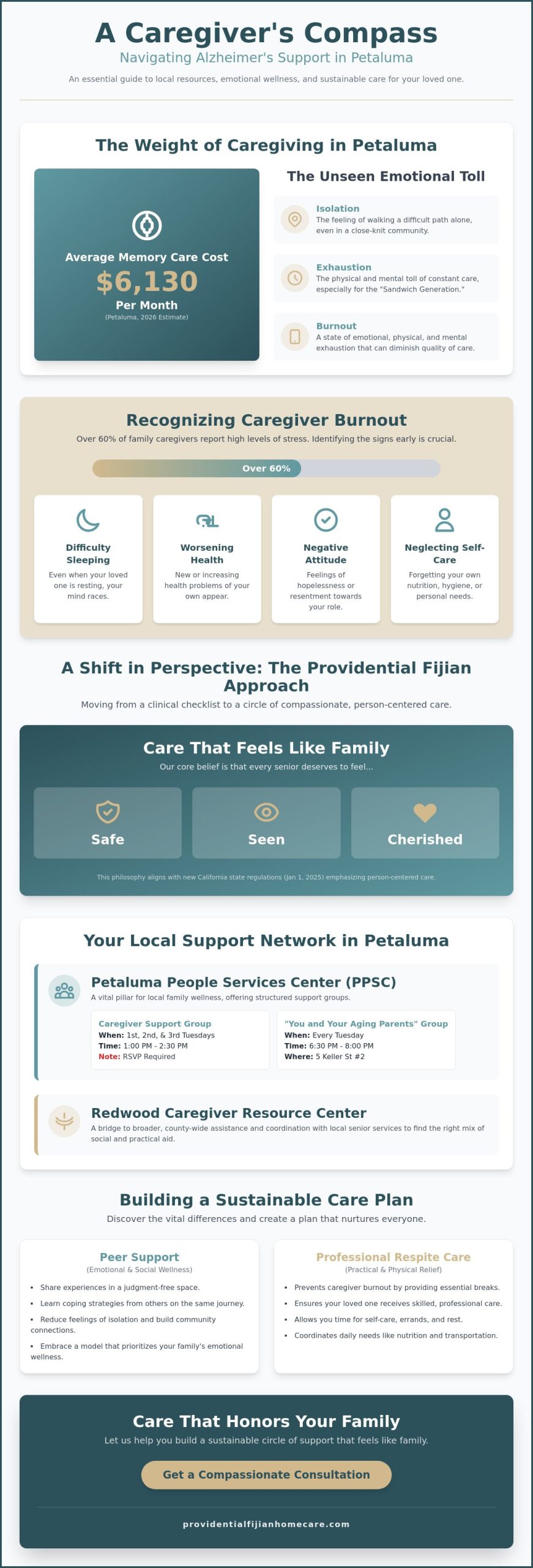
Last Tuesday at 2:00 AM, you might have found yourself sitting at a kitchen table here in Petaluma, feeling the heavy weight of a journey you never planned to take alone. It’s a quiet, exhausting reality for many, especially as the average cost of memory care in our city has reached $6,130 per month in 2026. You likely feel that your love should be enough, yet the physical and emotional toll of constant care often tells a different story. If you’re struggling with burnout or the heavy guilt of needing a break, please know that seeking support for families of Alzheimer’s patients Petaluma isn’t a sign of weakness. It’s an act of profound honor for your loved one.
We believe your family is the heart of the home, and you deserve a circle of care that holds you up while you hold them. This article provides a compassionate roadmap to local resources, including the Petaluma People Services Center support groups and the latest 2025 state regulations focused on person-centered care. You’ll discover how to access professional respite care and emotional networks that ensure your cherished elder remains safe, seen, and truly cherished. We’ll explore practical ways to find a local support group and secure the rest you need to continue this sacred walk with dignity and grace.
Key Takeaways
- Learn how to move beyond a purely clinical mindset to embrace a care model that prioritizes your family’s emotional wellness and social connection.
- Identify specific local meeting locations and professional resources for support for families of Alzheimer’s patients Petaluma to ensure you never walk this path alone.
- Discover the vital difference between peer support and professional respite care in preventing caregiver burnout and keeping your spirit nurtured.
- Master the practical steps to build a sustainable care plan that coordinates essential daily needs like nutrition and transportation with local senior services.
- Explore how integrating traditional values of respect can transform daily caregiving into an honorable service that makes your loved one feel truly cherished.
Navigating the Emotional Journey of Alzheimer’s in Petaluma
In the quiet neighborhoods of Petaluma, from the historic Victorian homes downtown to the sprawling dairy lands on the outskirts, a silent challenge often unfolds behind closed doors. Caring for a loved one with memory loss in a close-knit community brings a unique emotional weight. While our town feels like a small village where everyone knows your name, the private reality of dementia can feel incredibly isolating. Finding authentic support for families of Alzheimer’s patients Petaluma involves more than just managing a daily schedule; it requires a deep shift from clinical management to a focus on emotional and social wellness.
Many families in Sonoma County belong to the “Sandwich Generation,” balancing the needs of growing children in local schools with the increasing care requirements of aging parents. This dual role creates a pressure that can quickly lead to exhaustion. Adopting the perspective of a “Wise Nurturer” is essential for long-term health. This means viewing care not as a series of medical tasks to be checked off, but as a sacred journey that requires patience, cultural warmth, and a dedicated circle of support to sustain the family unit.
Recognizing Caregiver Burnout in Our Community
Living in the more rural or suburban areas of Petaluma can increase the sense of being alone on this path. Without daily interactions, red flags like chronic fatigue, irritability, or withdrawing from community events can go unnoticed. Caregiver burnout is a state of physical, emotional, and mental exhaustion that often includes a shift in attitude from positive to negative. It’s a serious condition that affects your ability to provide the “unconditional love” your family member deserves. Statistics from 2025 indicate that over 60% of family caregivers report high levels of stress, making it vital to identify these signs early. Common indicators include:
- Difficulty sleeping even when your loved one is resting.
- New or worsening health problems of your own.
- A feeling of hopelessness or resentment toward the caregiving role.
- Neglecting your own nutrition and hygiene.
The Power of Being ‘Safe, Seen, and Truly Cherished’
We believe in shifting the narrative of Dementia caregiving from a heavy burden to an honorable service. In our Fijian heritage, the elderly are never seen as a task to be managed; they’re the “heart of the home.” This cultural warmth removes the cold, clinical feel often found in traditional memory support. By maintaining the senior’s dignity, we ensure they remain safe, seen, and truly cherished through every stage of the disease. New California state regulations that went into effect on January 1, 2025, now emphasize this person-centered approach, encouraging families to seek support for families of Alzheimer’s patients Petaluma that allows their loved ones to age in place with profound respect.
Local Support Networks: Petaluma Resources for Memory Care Families
Finding authentic support for families of Alzheimer’s patients Petaluma starts with the realization that you don’t have to carry this sacred responsibility in isolation. Our community is rich with people who understand the specific rhythm of life in Sonoma County. While your loved one remains the heart of your home, even the most dedicated family needs a wider circle of care to maintain their own wellness. These local networks offer a space where your experiences are honored and your voice is heard without judgment.
The Petaluma People Services Center (PPSC) serves as a vital pillar for local family wellness. Their dedicated caregiver support group meets on the 1st, 2nd, and 3rd Tuesdays of each month from 1:00 pm to 2:30 pm. These sessions require an RSVP and are facilitated by trained therapists who provide a confidential environment to share the emotional highs and lows of the journey. For those who need an evening option, the “You and Your Aging Parents” group meets every Tuesday at 5 Keller St #2 from 6:30 pm until 8:00 pm. This group is particularly helpful for those balancing professional lives with caregiving duties.
Beyond our city limits, the Redwood Caregiver Resource Center offers a bridge to broader county-wide assistance. They help families coordinate with Petaluma Senior Services to find the right mix of social and practical aid. If the weight of daily tasks makes it difficult to attend these meetings, we invite you to have a gentle conversation with us about how professional respite can give you the time needed to reconnect with these support networks.
In-Person Support Groups in Petaluma
Stepping into your first meeting at the PPSC on H Street can feel overwhelming, but you’ll quickly find a community of “Wise Nurturers” who share your path. These meetings focus on the practicalities of navigating the Sonoma County healthcare system and the emotional release of shared stories. The bonds formed here often turn into lifelong friendships, ensuring that every caregiver feels safe, seen, and truly cherished by their peers. This local connection is a powerful tool for maintaining your mental health over the long term.
National Helplines with Local Knowledge
When a crisis occurs at an odd hour, the Alzheimer’s Association 24/7 Helpline provides immediate, expert guidance. For those who are homebound or prefer a digital connection, ALZConnected® acts as a 24-hour online community where you can post questions and receive support from others across Northern California. These digital bridges ensure that even if you can’t leave the house, you’re never truly alone. These resources, combined with local advocacy from the Northern California and Northern Nevada chapter, keep you informed about the latest care trends and legislative changes affecting our seniors.
Balancing Emotional Support with Practical In-Home Respite
While support groups provide a necessary embrace for the soul, they don’t wash the dishes or sit with your father while you sleep. Emotional networks are a vital foundation, but comprehensive support for families of Alzheimer’s patients Petaluma must eventually include physical hands and professional expertise. Many families find that while a group helps them process the grief of the journey, it doesn’t solve the 2:00 AM wake-up calls or the exhaustion of daily hygiene care. Comparing peer support with professional home care givers reveals a necessary balance between heart-centered listening and practical, skilled assistance.
A professional caregiver acts as a bridge that allows the family to remain whole. When you’re constantly monitoring safety or managing medications, your role as a daughter or spouse often fades into the background. Respite care is a vital health intervention that gives you the space to step back and breathe. It’s about more than just a “break.” It’s a strategic move to ensure you have the emotional stamina to continue your honorable service without losing your own health in the process. By inviting a trusted partner into your home, you gain the freedom to simply sit and hold your loved one’s hand again.
When Support Groups Aren’t Enough
Peer advice is invaluable, but it has limitations when your loved one faces complex behavioral changes or increased fall risks. You might notice signs that 1-on-1 safety supervision is no longer a luxury but a necessity. If your family member has started wandering or experiences high levels of agitation, the shared stories of a support group can’t replace the constant presence of a trained professional. Transitioning from emotional processing to practical care implementation is a natural step in honoring the “heart of the home.” It’s the moment when you realize that keeping them safe, seen, and truly cherished requires a dedicated team rather than a solo effort.
The Role of Professional In-Home Help for Seniors
Finding Help for Alzheimer’s Caregivers often means looking for someone who can handle the heavy lifting of daily life. An at home caregiver provides the physical break you need by taking over meal preparation, nutrition support, and gentle medication reminders. They offer cognitive engagement that keeps your loved one stimulated and connected to the world around them. Respite care reduces hospital readmissions by ensuring consistent monitoring at home. This steady presence allows you to focus on the meaningful connections that make your family unique, knowing the clinical and practical details are in capable, loving hands.
Building a Sustainable Care Plan for Your Loved One
Organizing a “care circle” isn’t just about logistics; it’s about surrounding your loved one with a community of love that can endure for the long term. In Petaluma, this means looking at your neighbors, local family, and professional partners as one cohesive unit. Establishing reliable support for families of Alzheimer’s patients Petaluma requires a blend of local presence and specialized skill. By spreading the responsibilities of care across multiple shoulders, you ensure that the quality of life for your cherished elder remains high while protecting your own well-being.
Integrating dementia care in Sonoma County into your daily routine shouldn’t feel like an intrusion. Instead, it should feel like a natural extension of your family’s rhythm. We believe in the importance of a “warm transition” when introducing a new caregiver. This isn’t a clinical hand-off; it’s a gentle introduction where we learn the stories, the favorite songs, and the small traditions that make your loved one feel safe. This slow, attentive pace mirrors the Fijian values of respect and ensures the transition is peaceful for everyone involved.
Creating a Safe Environment at Home
Petaluma’s historic Victorians and mid-century suburban homes each bring unique charms and specific safety challenges. Steep stairs, narrow hallways, or uneven flooring can quickly become hazards for someone with memory loss. Professional in-home help for seniors provides an extra pair of eyes to spot these risks before a fall occurs. Beyond physical safety, there is a profound psychological benefit to “aging in place.” Staying in the “heart of the home” surrounded by familiar sights and smells helps reduce the anxiety and confusion often triggered by unfamiliar environments.
Community Connections: Transportation and Errands
Maintaining a sense of normalcy is essential for the dignity of your loved one. Simple errands, like a trip to the local grocery store or a drive through the Petaluma hills, shouldn’t stop because of a diagnosis. Our caregivers provide dedicated transportation and errands, ensuring your family member can attend medical appointments in Santa Rosa or enjoy a social outing without the stress of navigating traffic. These continued community engagements keep the spirit bright and the mind connected to the world. If you’re ready to build a sustainable plan that honors your loved one’s heritage and home, start a conversation with us today.
Care That Feels Like Family: The Providential Fijian Approach
At Providential Fijian Home Care, we believe that the highest form of support for families of Alzheimer’s patients Petaluma is one that restores the natural harmony of the household. Our approach is deeply rooted in a generational tradition where caring for our elders is never viewed as a chore; it’s an honorable service. We don’t see ourselves as a distant agency. Instead, we act as a local, family-run pillar of the community, offering a warmth that transforms the caregiving experience into something truly sacred. By stepping into your home with unconditional respect, our caregivers become a compassionate extension of your own family, holding the space for you to simply be a loved one again.
We understand that the decision to bring someone into your home is a significant one. It’s why we prioritize a rhythm of care that is steady, welcoming, and unhurried. Our mission is to ensure that the transition feels less like a clinical intervention and more like a warm embrace. By May 2026, our internal family feedback has shown that this “Wise Nurturer” model significantly reduces the initial anxiety families feel when first seeking support for families of Alzheimer’s patients Petaluma. We’re here to walk beside you, ensuring that every step of this journey is paved with dignity and heartfelt dedication.
Honor and Dignity in Memory Care
The Fijian worldview places the elderly as the cherished heart of the home. This isn’t just a philosophy; it’s the foundation of how we train every member of our team in cultural warmth and unconditional love. We move beyond the basic completion of tasks to create meaningful connections with every client we serve. Whether it’s preparing a favorite meal or providing gentle medication reminders, we focus on the person behind the diagnosis. This holistic approach ensures that your family member remains safe, seen, and truly cherished, maintaining their dignity even as the disease progresses.
Your Next Steps Toward Peace of Mind
Reclaiming your peace of mind starts with a simple, low-pressure conversation. We don’t believe in high-pressure consultations or generic care packages. Instead, we sit down with you to listen to your story and understand your family’s unique Petaluma lifestyle. Whether you need a few hours of respite care each week or more consistent companion support, we customize a plan that fits your specific needs. We invite you to join our community of supported families where kindness and honor are the standard of care. This journey is difficult, but you don’t have to walk it alone; let us offer the strength and warmth your family deserves.
Honoring Your Journey with a Circle of Care
You’ve explored the landscape of local resources, from the supportive rooms of the Petaluma People Services Center to the vital role of professional respite. You now understand that a sustainable care plan requires balancing your own emotional wellness with practical, hands-on assistance. True support for families of Alzheimer’s patients Petaluma is about more than just managing symptoms; it’s about preserving the dignity of the person who has always been the heart of your home.
Since 2016, Providential Fijian Home Care has been dedicated to providing specialized Alzheimer’s and dementia respite care throughout Petaluma, Santa Rosa, and the greater Sonoma County area. We bring our traditional Fijian cultural values of respect and warmth to every family we serve, ensuring your loved one feels safe, seen, and truly cherished. You don’t have to navigate this path in isolation. We invite you to start a heartfelt conversation about your family’s care needs today. Your strength as a caregiver is a gift, and it’s an honor for us to help you protect it.
Frequently Asked Questions
What local support groups are available for Alzheimer’s families in Petaluma?
The Petaluma People Services Center (PPSC) hosts a dedicated caregiver support group on the 1st, 2nd, and 3rd Tuesdays of every month from 1:00 pm to 2:30 pm. For those seeking evening options, the “You and Your Aging Parents” group meets every Tuesday at 6:30 pm at 5 Keller St #2. These local gatherings provide essential support for families of Alzheimer’s patients Petaluma by offering a confidential space to share experiences with others on a similar journey.
How can I tell if I am experiencing caregiver burnout?
You may be experiencing burnout if you feel chronic exhaustion, irritability, or a sense of hopelessness that doesn’t lift after sleep. Statistics from 2025 show that over 60% of family caregivers report high levels of stress, which often manifests as neglecting your own nutrition or withdrawal from community activities. If you find yourself unable to sleep even when your loved one is resting, it’s a significant red flag that your emotional and physical health needs immediate attention.
Is there financial assistance for respite care in Sonoma County?
Financial help is available through several avenues, including the VA Aid and Attendance benefit, which can provide up to $2,431 per month for a married veteran in 2026. Additionally, the maximum Supplemental Security Income (SSI) for an individual is $994 per month, which can be used toward in-home support. The Redwood Caregiver Resource Center also offers limited respite grants and vouchers specifically for families in Sonoma County who need a temporary break from their caregiving duties.
Can professional caregivers help with Alzheimer’s patients who wander?
Professional caregivers are specifically trained to provide 1-on-1 safety supervision for seniors who experience wandering or exit-seeking behaviors. By focusing on meaningful engagement and environmental safety, they ensure your loved one remains safe, seen, and truly cherished within the home. This constant presence allows the family to rest, knowing that a dedicated professional is monitoring the “heart of the home” and preventing potential accidents or elopement during high-risk times of the day.
What is the difference between a support group and respite care?
A support group offers emotional peer connection and professional guidance to help you process the grief and stress of the journey. In contrast, respite care provides physical, hands-on relief where a professional caregiver takes over daily tasks like meal preparation and personal hygiene. While a group provides the support for families of Alzheimer’s patients Petaluma needed for mental health, respite care gives you the actual time and space to step away and recharge your physical energy.
How do I introduce a caregiver to a loved one who is resistant to help?
We recommend a “warm transition” where the caregiver is introduced as a “friend” or a “helper” for a specific task, such as meal preparation or light housekeeping. Start with short, low-pressure visits that focus on companion activities like sharing tea or looking at old photos. This gentle approach honors the senior’s dignity and allows a relationship to form naturally, eventually making the caregiver feel like a compassionate extension of your own family rather than an intruder.
What should I bring to my first Petaluma support group meeting?
You only need to bring yourself and an open heart to your first meeting at the Petaluma People Services Center or other local venues. Some caregivers find it helpful to bring a notebook to jot down local resources or tips shared by peers, but no medical records or formal documentation are required. These meetings are designed to be a low-pressure environment where your only responsibility is to receive the kindness and understanding of the community.
Are there Spanish-speaking Alzheimer’s support resources in the North Bay?
The Alzheimer’s Association Northern California chapter and the Redwood Caregiver Resource Center both provide bilingual literature and staff to support the Latino community. These organizations offer culturally sensitive guidance and can connect families with Spanish-speaking support networks across Sonoma County. Ensuring that every family feels respected and understood is a priority, and these resources help bridge the gap for those who prefer to navigate this journey in their native language.