
You might find yourself holding your breath every time you hear a floorboard creak in the middle of the night, wondering if your loved one is wandering toward the stairs or a cold kitchen. It’s a heavy burden to carry the constant vigilance required to maintain home safety for Alzheimer’s patients while trying to honor their independence. You aren’t alone in this struggle. Many families in Santa Rosa feel the same exhaustion and guilt as they try to balance a nurturing environment with the reality that 55% of all senior fall-related injuries occur inside the home, according to January 2026 data.
We believe that the elderly are the heart of the home, and protecting them is a sacred privilege. You can transform your house into a sanctuary of safety and dignity without making it feel like a clinical facility. This article provides a compassionate, room-by-room checklist tailored for Sonoma County families. You’ll learn practical steps to prevent wandering, secure the kitchen, and gain the peace of mind you deserve while ensuring your loved one remains safe, seen, and truly cherished.
Key Takeaways
- Learn the specific kitchen and bathroom modifications that prevent accidents while maintaining a sense of home and dignity.
- Discover how to manage sensory changes and shadows to prevent wandering and reduce distress for your cherished loved one.
- Ensure your family is ready for local emergencies with a dementia-friendly evacuation plan designed for Santa Rosa wildfire safety.
- Find out how to improve home safety for Alzheimer’s patients by recognizing when professional support becomes an act of heartfelt dedication.
Understanding Home Safety for Alzheimer’s Patients: Why the Environment Matters
Creating a safe environment isn’t about building a cage; it’s about nurturing a sanctuary. True home safety for Alzheimer’s patients exists as an evolving partnership between the physical space and the person’s changing needs. In our Fijian heritage, we view the elderly as the “heart of the home.” This perspective shifts the focus from managing risks to honoring a sacred space where a loved one deserves to feel both protected and respected. A dementia-friendly home is a space that minimizes confusion while maximizing comfort.
As the condition progresses, it fundamentally alters how a person experiences the world around them. Alzheimer’s often impairs depth perception, making a dark rug look like a deep hole or a glass of water difficult to locate on a clear table. Balance becomes precarious as the brain struggles to process spatial relationships, leading to the shuffling gait that increases fall risks. Even the sense of smell can diminish, which means a loved one might not detect the scent of a forgotten meal burning on the stove. Recognizing these sensory shifts is the first step in providing care that feels like family.
How Memory Loss Changes Home Navigation
For decades, your loved one has navigated their house using an internal “map” built on habit and history. As dementia progresses, this cognitive map begins to fail. A hallway that was once familiar can suddenly feel like a foreign path, leading to deep emotional distress. Imagine the heartbreak of feeling “lost” in the very living room where you raised your children. This disorientation often triggers “sundowning” or increased agitation during the evening hours. For families seeking to understand these transitions better, our guide on dementia care in Sonoma County offers deeper stage-specific insights to help you stay ahead of these changes.
The Balance Between Safety and Dignity
We often see Santa Rosa families worry that safety means turning a cherished home into a cold hospital ward. It doesn’t have to be that way. You can maintain a sense of “unconditional love” by keeping meaningful mementos accessible while using discreet home automation safety features to provide a layer of protection. The goal is to keep your loved one safe, seen, and truly cherished without stripping away their identity. However, you must watch for “red flag” behaviors that signal it’s time for immediate modifications. These include frequent bruising from bumps, leaving the sink running, or expressing fear of specific rooms. When these signs appear, adjusting the environment becomes an act of heartfelt dedication rather than a chore.
The Essential Room-by-Room Safety Checklist
Walking through your front door should always feel like a warm embrace. Yet, for many Santa Rosa families, the home can begin to feel like a series of obstacles rather than a sanctuary. Improving home safety for Alzheimer’s patients involves making small, thoughtful changes that preserve dignity while minimizing risk. By approaching each room with a spirit of “honorable service,” you can create an environment where your loved one feels safe, seen, and truly cherished.
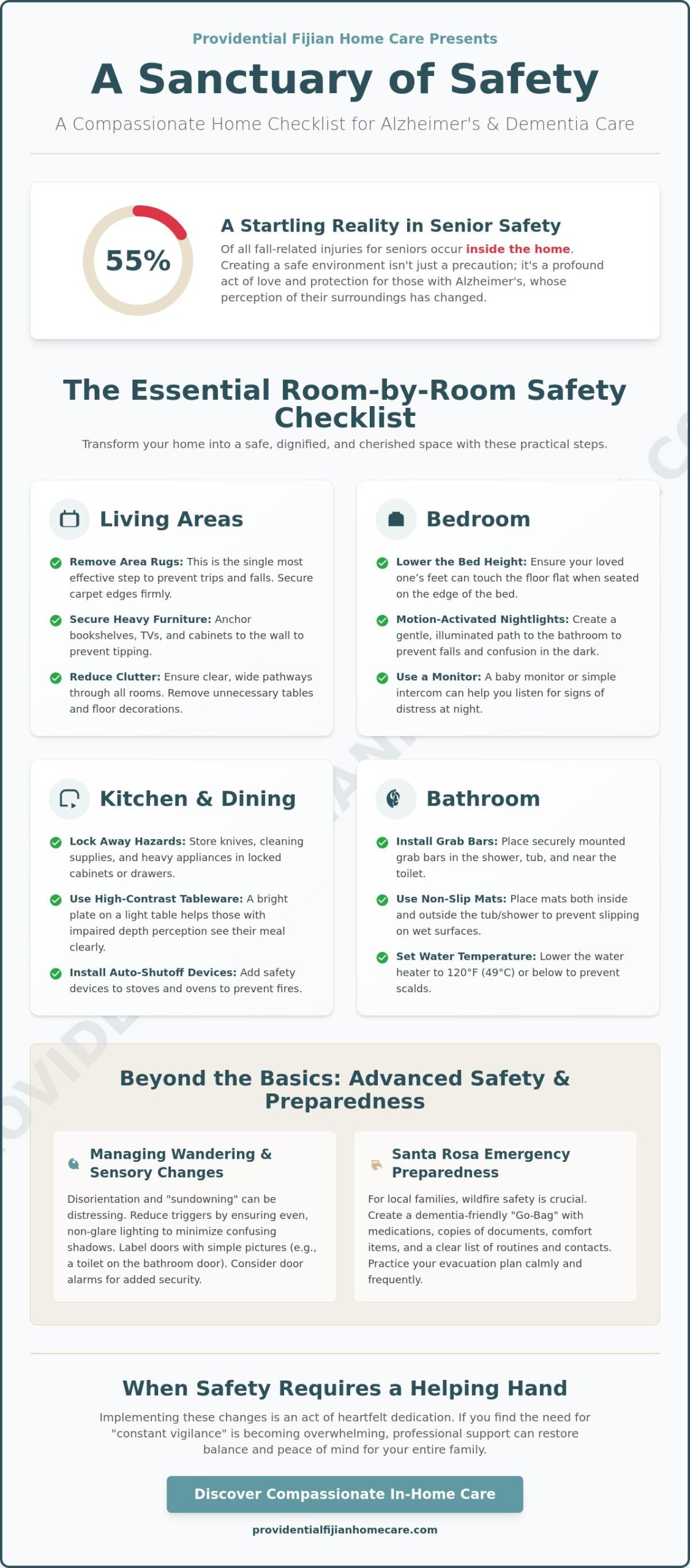
Start by addressing the living room, where comfort should never come at the cost of security. Area rugs are the leading cause of falls in the home; removing them entirely is the single most effective step you can take today. Secure heavy furniture, such as bookshelves and television stands, directly to the wall to prevent tipping if a loved one uses them for balance. In the bedroom, lower the bed height to ensure their feet touch the floor easily when sitting on the edge. Motion-activated nightlights are essential here, as they provide a gentle path to the bathroom without the confusion of fumbling for a light switch in the dark.
Kitchen and Dining Area Modifications
The kitchen is often the heart of the home, but it requires careful adaptation to remain a safe space. Practice “out of sight, out of mind” storage by keeping knives, heavy mixers, and cleaning supplies in locked cabinets. To help with visibility, use high-contrast plates; for example, a bright red plate on a light wood table helps someone with depth perception issues distinguish their meal. If managing the kitchen has become a source of “constant vigilance” for you, our meal preparation and nutrition support can help prevent accidents while ensuring your loved one enjoys healthy, home-cooked food. You might also consider installing auto-shutoff devices on stoves to provide an extra layer of protection.
Bathroom Safety: Preventing Falls and Scalding
Bathrooms are high-risk areas due to slippery surfaces and complex tasks. To prevent accidental burns, set your water heater to exactly 120°F. When it comes to stability, suction-cup grab bars are never enough; only professional-grade, wall-mounted bars offer the security needed during transfers. You can transform this space from a source of anxiety into a “spa-like” environment by using warm towels, soft lighting, and non-slip mats. For more comprehensive guidance, the Alzheimer’s Association safety tips offer an excellent foundation for these home modifications. If the weight of managing these changes feels overwhelming, a gentle conversation about respite care can help you find the support your family deserves.
Managing Sensory Changes and Preventing Wandering
As the sun begins to dip behind the Sonoma Mountains, many families notice a shift in their loved one’s behavior. Sundowning increases safety risks in the late afternoon for Santa Rosa seniors as the fading natural light often triggers confusion, anxiety, and a restless urge to wander. Protecting the “heart of the home” during these hours requires a deep understanding of how dementia reshapes the senses. Effective home safety for Alzheimer’s patients isn’t just about physical barriers; it’s about soothing the mind through environmental clarity and unconditional love.
The “Mirror Effect” is a common but often overlooked source of distress. To someone with advanced memory loss, a reflection may no longer be recognized as their own face but rather as a stranger standing in the room. This can lead to fear or even defensive reactions. Covering mirrors with decorative fabric or removing them from common areas can instantly restore a sense of peace. Similarly, your lighting strategy must be intentional. Harsh shadows on the floor can be mistaken for deep holes or intruders, leading to falls or refusal to move. Ensuring a comprehensive Alzheimer’s Association Home Safety Checklist is followed will help you identify these subtle sensory triggers throughout your living space.
Wandering prevention often starts with simple, visual cues that respect a person’s dignity. Placing a large, red “STOP” sign on exit doors can be surprisingly effective, as the brain often retains the meaning of basic safety symbols long after other logic fades. For added security, consider installing deadbolts or slide locks either very high or very low on the door frame, well outside the normal line of sight. These modifications allow for home safety for Alzheimer’s patients without making the environment feel restrictive or clinical.
Visual and Auditory Cues for Clarity
Helping your loved one navigate their day involves providing clear, simple markers. Labeling doors with high-contrast pictures, such as a photo of a toilet for the bathroom, reduces the panic of being lost in a familiar place. It’s also vital to manage the “soundscape” of the home. Constant background noise from a television or a loud radio can cause overstimulation, making it harder for a senior to process instructions or feel safe. Using color contrast, like a dark chair against a light wall, helps them distinguish objects and move with greater confidence.
Creating a Safe Perimeter
For families in Windsor or Healdsburg with larger yards, the perimeter of the home is just as important as the interior. Secure fencing and gated gardens allow your loved one to enjoy the fresh Sonoma County air without the risk of walking into traffic. While smart home sensors and door alarms provide an essential layer of peace of mind, they are most effective when paired with a person-centered approach. Our compassionate caregiver agency in Santa Rosa provides the human “watchful eye” that technology simply cannot replace, ensuring your family member is always safe, seen, and truly cherished.
Santa Rosa Specific Emergency Preparedness for Dementia
Living in Sonoma County offers breathtaking beauty, but it also requires us to be uniquely prepared for natural challenges. For families managing home safety for Alzheimer’s patients, a wildfire or a sudden power outage isn’t just an inconvenience; it’s a potential crisis that can cause profound confusion. Protecting the “heart of the home” means having a plan that accounts for the emotional fragility of a loved one with memory loss. We approach this preparation with a spirit of “honorable service,” ensuring that even in chaos, your family member feels safe, seen, and truly cherished.
The first step in local readiness is ensuring your loved one’s residence is registered with SoCoAlert, the official emergency notification system for Sonoma County. This system provides localized warnings via landline, cell phone, or email. Beyond digital alerts, build a “circle of care” by introducing your loved one to at least three immediate neighbors. Share the Alzheimer’s diagnosis with them so they can assist first responders if you aren’t present during an evacuation. Keeping a physical list of these contacts, along with local Santa Rosa first responders, near the front door provides a vital lifeline when every second counts.
The ‘Go-Bag’ for Alzheimer’s Patients
An evacuation can be terrifying for someone who relies on the “mapping” of a familiar home to feel secure. Your “Go-Bag” should prioritize “calm” as its most essential item. Include a current medication list and a recent photo of your loved one taken within the last six months to help identify them if you become separated. Pack a “comfort kit” with a familiar scent, like a favorite blanket or a well-worn sweater, along with simple, high-protein snacks they enjoy. When communicating with Santa Rosa first responders during a crisis, clearly state: “My family member has dementia and may become agitated or non-verbal under stress.” This simple sentence helps them approach with the necessary patience and cultural warmth.
Power Outage Safety in Sonoma County
PG&E’s Public Safety Power Shutoffs (PSPS) are a frequent reality for families in the North Bay. A sudden loss of light significantly increases the risk of falls. As we’ve seen, 55% of indoor injuries among seniors occur during these moments of instability. Install battery-operated, motion-sensing lights in hallways and bathrooms that activate immediately when the grid goes down. During Sonoma County heat waves, a power outage can quickly lead to overheating, which exacerbates dementia symptoms. Have a pre-arranged plan for a “cooling center” at a friend’s house or a local hotel with backup power. Our home care givers are specifically trained to assist with these stressful transitions, providing the steady presence your family needs during an outage.
If you’re worried about managing the next wildfire season alone, reach out for a supportive conversation about how our specialized care can provide your family with true peace of mind.
When Safety Requires a Helping Hand: Professional Support
There often comes a moment when the weight of constant vigilance begins to feel heavy on your shoulders. You’ve spent months, perhaps years, adjusting every rug and labeling every drawer to ensure home safety for Alzheimer’s patients. It’s important to realize that accepting support isn’t a sign of weakness or a loss of independence. Instead, it’s a profound act of love. By inviting a professional into your home, you aren’t stepping away; you’re strengthening the circle of protection around the person who remains the heart of your home.
Professional caregivers bring a set of “fresh eyes” to a living space. When you live in a house every day, you might become habituated to a loose floorboard or a dimly lit corner. Our team is trained to identify these subtle safety hazards that family members often overlook. We view our work as an honorable service, where every modification and every watchful moment is a tribute to the dignity of your loved one. This dedicated support allows you to transition from being a full-time “safety officer” back to being a son, daughter, or spouse.
Respite care is a vital part of this journey. To remain patient and vigilant, you need moments to rest and tend to your own well-being. When you are exhausted, it’s harder to maintain the “cultural warmth” and calm environment that prevents your loved one from feeling anxious. Our Fijian heritage teaches us that caring for an elder is a sacred privilege. We don’t just provide a service; we offer a warm embrace that ensures your family member feels safe, seen, and truly cherished every single hour of the day.
The Role of Companion Care in Safety
Safety is as much about emotional stability as it is about physical barriers. Companion care plays a critical role in reducing the anxiety that often leads to “pacing” or “wandering” behaviors. By engaging your loved one in safe, cognitive activities and meaningful conversation, we keep their mind focused and calm. Medication reminders also serve as a core pillar of home safety for Alzheimer’s patients, preventing the confusion or physical setbacks that occur from missed or double doses. This proactive engagement turns potential “danger zones” into spaces of joyful, secure connection.
Starting the Conversation with Providential Fijian Home Care
Our commitment to the Santa Rosa and Sonoma County community is rooted in heartfelt dedication and generational tradition. We understand the unique challenges local families face, from navigating wildfire season to managing the daily nuances of memory loss. We invite you to start a gentle conversation with our team to discuss your specific needs. We can schedule a local home safety assessment to help you identify the best ways to protect your cherished elder. Let us help you keep your loved one safe and cherished at home with care that feels like family.
Embracing a Sanctuary of Safety and Honor
Creating a secure environment for your loved one is a journey of heartfelt dedication. By implementing thoughtful room-by-room modifications and addressing sensory triggers like lighting and mirrors, you’ve taken vital steps toward a more peaceful home. You’ve also learned how to prepare for local Sonoma County emergencies, ensuring that even during wildfire season or power outages, your family remains resilient and connected. Every small change you make contributes to the essential goal of improving home safety for Alzheimer’s patients while preserving their cherished dignity.
Since 2016, we’ve had the privilege of serving families across Santa Rosa with care that is rooted in family and focused on honor. Our specialized Fijian caregivers are deeply trained in memory support and view the elderly as the true heart of the home. You don’t have to carry the weight of constant vigilance alone. We invite you to Schedule a Heartfelt Conversation and Home Safety Assessment to see how we can support your unique needs. Together, we can ensure your loved one feels safe, seen, and truly cherished in the home they love. You’re doing a wonderful job, and we’re here to walk this path beside you.
Frequently Asked Questions
Is it safe for someone with Alzheimer’s to live alone in Santa Rosa?
It is rarely safe for an individual with a progressive dementia diagnosis to live alone without a dedicated support system. While independence is cherished, the risks of forgotten appliances or disorientation are high. Families should consider that 1 in 3 older adults dies with Alzheimer’s or another dementia, making consistent companionship essential to ensure they remain safe, seen, and truly cherished.
What are the most common home accidents for dementia patients?
Falls are the leading cause of fatal and non-fatal injuries among seniors, with 55% of these incidents occurring inside the home as of January 2026. Other frequent accidents include kitchen fires from unattended stoves and medication errors. These risks highlight why home safety for Alzheimer’s patients must prioritize both physical modifications and a watchful, loving eye to prevent harm.
How can I prevent my loved one from wandering out of the house at night?
You can prevent nighttime wandering by installing deadbolts or slide locks either very high or very low on door frames, well away from the normal line of sight. Simple door alarms or smart sensors provide an immediate alert if an exit is attempted. These tools, combined with motion-activated lighting, help maintain a secure perimeter while honoring the peace of your home.
Should I remove all the rugs in my house for a dementia patient?
Yes, removing all area rugs and throw rugs is one of the most effective ways to prevent falls. Even rugs with non-slip backing can cause a shuffle or trip for someone with impaired depth perception. Keeping floors clear and consistent creates a predictable path for your cherished elder, reducing the anxiety of navigating their living space.
How do I prepare a dementia patient for a wildfire evacuation in Sonoma County?
Start by registering the home with SoCoAlert to receive immediate notifications for Sonoma County. Pack a Go-Bag that includes a seven day supply of medications, a recent photo from within the last six months, and a comfort item like a favorite blanket to reduce distress. Clear communication with first responders about the dementia diagnosis is vital for a calm, safe transition during a crisis.
Can technology like GPS trackers help with Alzheimer’s safety?
Wearable GPS trackers and in-home sensors are valuable tools for monitoring movement and detecting falls in real time. These technologies provide peace of mind, but they should always be used as a supplement to human connection. Nothing replaces the warmth and unconditional love provided by a caregiver who can respond to emotional needs that a device cannot detect.
What should I do if my loved one becomes agitated during home modifications?
If a loved one becomes distressed, slow the process down and make changes gradually rather than all at once. Try to frame modifications as a way to make the home more comfortable rather than a set of rules. Maintaining a calm, unhurried rhythm helps your family member feel respected and secure during the transition. Improving home safety for Alzheimer’s patients is a journey that requires patience and heartfelt dedication.
How do I know when it’s no longer safe for my loved one to stay at home?
Critical signs include frequent falls, wandering into the neighborhood, or the inability to manage basic hygiene. If a family caregiver feels constant vigilance is leading to total exhaustion, it is time to seek professional support. Transitioning to a higher level of care is an act of love that ensures your family member remains in a safe, nurturing environment.