

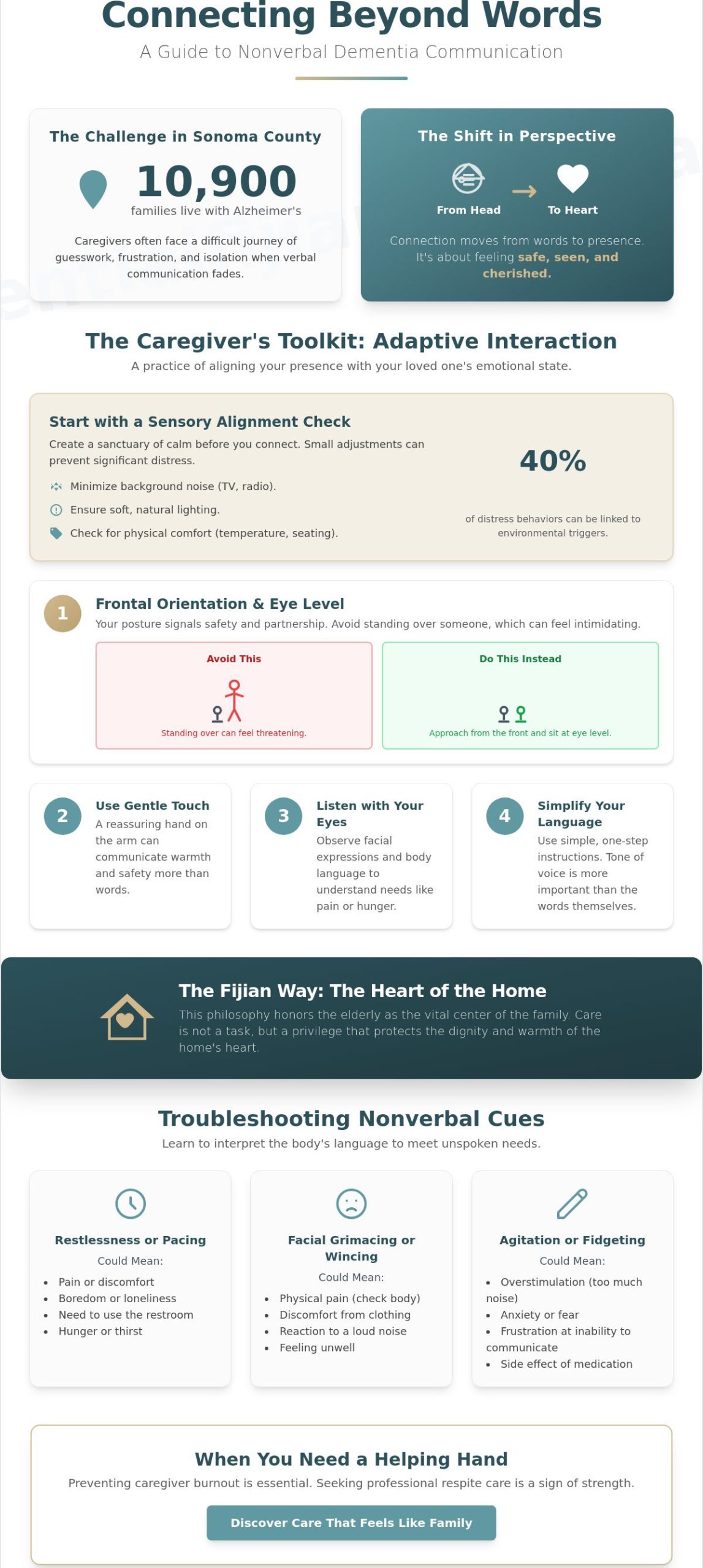
Imagine sitting in a sunlit room in Santa Rosa, looking into the eyes of someone who has been your anchor for decades. You want to ask how they’re feeling, but the words won’t come for them anymore. You might feel a heavy sense of loss when communicating with a nonverbal dementia patient, wondering if the person you love is still reachable behind the silence. It’s a deeply painful struggle shared by the 10,900 families in Sonoma County currently living with Alzheimer’s. You’re likely exhausted by the constant guesswork of trying to distinguish a cry for water from a cry of pain, and that frustration can quickly lead to a sense of isolation for both of you.
We believe that connection isn’t lost when words fade; it simply moves from the head to the heart. You can restore a sense of emotional intimacy by learning to speak a language rooted in dignity and “cultural warmth.” This guide will show you how to use compassionate, non-verbal techniques like “Adaptive Interaction” to make your loved one feel safe, seen, and truly cherished once again. We’ll explore how to reduce agitation through sensory cues and show you how to find dedicated local support so your family can find peace in this journey.
Key Takeaways
- Learn to bridge the silence by viewing your presence as a powerful form of connection rather than a lack of speech.
- Master “Adaptive Interaction” techniques for communicating with a nonverbal dementia patient to transform your Santa Rosa home into a sanctuary of understanding.
- Discover the Fijian philosophy of treating the elderly as the “heart of the home,” ensuring your loved one feels safe, seen, and truly cherished.
- Gain a framework for interpreting physical cues like restlessness or facial expressions to accurately meet needs for comfort, hunger, or pain relief.
- Understand when to seek professional respite care to prevent caregiver burnout while maintaining the “Care That Feels Like Family” your loved one deserves.
Understanding the Language of the Heart: What is Nonverbal Dementia Communication?
When the familiar rhythm of daily conversation begins to fade, it’s natural to feel a heavy sense of loss. You might find yourself waiting for a response that doesn’t come, or searching for the right words to fill a quiet room in your Santa Rosa home. However, communicating with a nonverbal dementia patient isn’t about managing an absence of language. Instead, it’s about discovering a bridge of presence that exists beyond the spoken word. This shift requires us to stop listening with our ears and start listening with our hearts, recognizing that a person’s spirit remains vibrant even when their vocabulary has slipped away.
We often view silence as a barrier, but in the “Fijian Way” of care, we see it as an invitation to a deeper level of intimacy. By Understanding Dementia and how it affects the brain’s processing centers, we can release the expectation of traditional speech. This allows us to focus on the “soul’s dialogue,” a profound connection where your loved one is safe, seen, and truly cherished through your touch, your gaze, and your steady, loving presence.
Why Words Fade: The Progression of Dementia
As Alzheimer’s or other forms of dementia progress, the brain’s language centers, specifically the temporal and frontal lobes, undergo significant cognitive changes. This physical shift makes it increasingly difficult for a person to retrieve specific words or follow complex sentences. It’s a transition from “head-centered” logic to “heart-centered” interaction. During this stage, patience becomes your most powerful tool. When you aren’t rushing to fill the silence, you create a peaceful space where your loved one doesn’t feel the pressure to perform or explain, allowing their dignity to remain fully intact.
The Emotional Impact on Sonoma County Families
There is a unique kind of grief that comes with losing the ability to share stories or hear a “thank you” from a parent or spouse. In Sonoma County, where an estimated 10,900 people over the age of 65 are living with Alzheimer’s, many families are navigating this emotional terrain together. It’s important to honor the person’s remaining presence rather than focusing solely on what has been lost. We believe that caring for the elderly is an honorable service and a privilege. By embracing this new way of communicating with a nonverbal dementia patient, you aren’t just providing care; you’re protecting the “heart of the home” and maintaining a bond that is far more resilient than any spoken word. Nonverbal communication is the soul’s dialogue that persists long after words are gone.
The Caregiver’s Toolkit: 5 Proven Strategies for Communicating with a Nonverbal Patient
Mastering the art of communicating with a nonverbal dementia patient requires a shift from verbal logic to what we call “Adaptive Interaction.” This is a daily practice of aligning your physical presence with your loved one’s emotional state. In a Santa Rosa home setting, where the environment can sometimes feel cluttered or loud, this practice begins with creating a sanctuary of calm. By adopting the slow and steady rhythm characteristic of Fijian care, you allow your loved one the time they need to process your presence without feeling rushed or overwhelmed.
Before you begin any interaction, it’s vital to perform a sensory alignment check. This ensures the environment supports connection rather than hindering it. You should minimize background noise from televisions or radios, ensure the room has soft, natural light, and check that your loved one is physically comfortable. These small adjustments can reduce agitation significantly, as research from March 2026 indicates that environmental triggers are responsible for up to 40% of distress behaviors in late-stage dementia.
Step 1: Frontal Orientation and Eye Level
Standing over someone who is seated or in bed can unintentionally feel threatening or authoritative. To foster a sense of safety, always approach from the front and move slowly. Sit at or slightly below their eye level. This simple change in posture signals that you’re a partner in their care, not a stranger making demands. Maintaining soft, consistent eye contact tells them they are safe, seen, and truly cherished, even when words aren’t part of the exchange.
Step 2: The Power of Therapeutic Touch
In our Fijian heritage, we view the elderly as the “heart of the home,” and touch is a primary way we show reverence. There’s a profound difference between “task-oriented touch,” such as moving an arm to put on a sleeve, and “affectionate touch.” A gentle hand on the shoulder or holding their hand for a few minutes communicates “you are safe” more effectively than any sentence could. This form of connection honors their dignity and reinforces the bond of family that persists through the illness. If you find yourself struggling to maintain this level of emotional presence, a conversation about dementia support might help you find the balance you need.
Step 3: Mirroring and Facial Expressions
Your face is the most powerful communication tool you possess. Mirroring involves reflecting the emotion your loved one is showing. If they look worried, a concerned but calm expression validates their internal reality. Once they feel understood, you can slowly transition your expression to a gentle smile, leading them toward a more peaceful state. Mirroring validates the patient’s internal reality, showing them that they aren’t alone in their feelings, which is the cornerstone of “Care That Feels Like Family.”
The Fijian Way: Bringing Cultural Warmth to Memory Care in Santa Rosa
In our culture, we don’t see aging as a decline. We see it as an arrival at a place of deep respect. The concept of the elderly as the “heart of the home” is central to everything we do at Providential Fijian Home Care. This philosophy transforms the act of communicating with a nonverbal dementia patient from a stressful challenge into a sacred opportunity for connection. When you view your loved one as the most honored member of your household, your energy shifts. You move slower. You speak softer. You listen with a different kind of intensity that the patient can feel, even if they can’t understand your words.
For families living in Petaluma and Windsor, the demands of modern life often clash with the slow, attentive needs of a senior with memory loss. Introducing “cultural warmth” into your daily routine creates a sanctuary of safety. It’s about more than just physical safety; it’s about emotional security. You can find more localized advice in our Dementia Care in Sonoma County: A Compassionate Guide for Local Families, which highlights how our community-based model supports these values.
Reverence and Dignity in Every Interaction
Treating a person with honor fundamentally changes the caregiver’s internal state. One of the most important ways to maintain this dignity is by avoiding “elderspeak.” This is the common tendency to use baby talk, high-pitched tones, or overly simplified sentences. Research published in late 2025 shows that seniors with dementia are highly sensitive to tone; using elderspeak can actually trigger a 25% increase in resistive behaviors. Instead, speak to your loved one as the adult they have always been. In the Fijian tradition, patience isn’t just a virtue; it’s a gift you offer to a cherished elder. By giving them the gift of time, you validate their worth.
Creating a “Safe and Seen” Environment
Busy Bay Area homes are often filled with the hum of life, but for a nonverbal patient, this can be overwhelming. Background noise from televisions, loud appliances, or traffic can create a “wall of sound” that makes communicating with a nonverbal dementia patient nearly impossible. You can create a more supportive atmosphere with a few intentional changes:
- Lower the volume: Turn off unnecessary electronics to reduce auditory clutter.
- Soft lighting: Use warm lamps to reduce the harsh shadows that often cause confusion or fear.
- Familiar scents: Incorporate local scents, like the lavender found in Sonoma Valley, to provide a grounding sensory experience.
Try positioning your loved one so they have a clear view of the natural beauty of our Sonoma County landscapes. Seeing the movement of trees or the shifting light on the hills can be incredibly therapeutic. This simple connection to the world outside helps them feel safe, seen, and truly cherished in their own home.
Troubleshooting Common Nonverbal Cues: Interpreting Pain, Hunger, and Mood
In the quiet moments of caregiving, it’s easy to feel overwhelmed by a sudden outburst or a period of intense restlessness. However, we operate under a single, guiding truth: all behavior is communication. When you are communicating with a nonverbal dementia patient, their actions are the only tools they have left to express an unmet need. Instead of viewing agitation as a problem to be solved, we view it as a message to be decoded. This mindset allows you to maintain the dignity of your loved one while providing the “Care That Feels Like Family” they deserve.
Common signals like facial grimacing, clenched teeth, or repetitive movements often serve as the first signs of physical distress. Since the updated 2026 regulations for Residential Care Facilities for the Elderly (RCFEs) went into effect, there’s been a renewed focus on person-centered observation because traditional pain scales often fail those who cannot speak. If you notice your loved one shifting constantly or pulling at their clothing in the late afternoon, they may be experiencing “sundowning.” This pattern of restlessness often peaks as the sun sets, requiring a gentle, anchoring presence to help them feel safe, seen, and truly cherished through the transition into evening.
Decoding Agitation and Restlessness
When agitation arises, we first look for physical causes. Is it a basic need like hunger, thirst, or the need to use the bathroom? Sometimes, the environment in a Santa Rosa home might be too cold or perhaps too bright. If physical needs are met, we turn to emotional needs. Fear and loneliness are powerful triggers for nonverbal patients. In these moments, we use “Validation Therapy.” Instead of correcting their reality, you agree with the emotion they’re showing. If they seem frightened, you don’t say “there’s nothing to be afraid of.” You say, “I can see you’re feeling scared, and I’m right here with you.” This honors their internal experience and reduces the need for louder, more distressed behavior.
The “Heart-to-Heart” Check-in
Before you attempt to soothe your loved one, you must first soothe yourself. Take a deep breath to regulate your own nervous system. Your “cultural warmth” as a caregiver acts as a mirror for the patient. If you’re tense, they’ll likely become tense as well. We often speak of the “contagion of calm” between a caregiver and a loved one, where your steady heart rate and peaceful energy can physically lower their anxiety. If the daily task of decoding these needs feels like too much to carry alone, exploring In-Home Help for Seniors in Santa Rosa can provide the professional respite you need to remain a patient, loving presence.
You don’t have to navigate these silent signals by yourself. Our team is here to offer the specialized support your family needs to find peace again. Start a conversation with us today to learn how our compassionate care can help your loved one feel truly supported.
When You Need a Helping Hand: Professional Memory Support in Santa Rosa
The journey of communicating with a nonverbal dementia patient is a path paved with profound love, but it’s also one that requires immense resilience. You’ve learned to listen with your heart and decode the silent language of your loved one, yet even the most dedicated family member needs a moment to breathe. Acknowledging that you need support isn’t a sign of weakness; it’s a testament to your commitment to providing the best possible care. In Sonoma County, where the cost of specialized memory care facilities can average $8,810 per month, finding high-quality, compassionate home support is a vital alternative that keeps your loved one in the familiar surroundings they cherish.
Finding the right support starts with Finding a Compassionate Caregiver Agency in Santa Rosa that understands the delicate nuances of memory loss. Our caregivers are trained not only in the technical aspects of memory care but also in the Fijian values of unconditional respect. In California, residential care staff must complete 40 hours of initial training, with 12 hours specifically focused on dementia. We build upon this foundation by integrating the concept that the elderly are the “heart of the home.” This ensures that while you take the time to restore your own energy, your loved one remains safe, seen, and truly cherished by someone who views their care as an honorable service.
Respite Care for Sonoma County Families
Taking a break is an act of love, not a failure. It allows you to return to your role as a daughter, son, or spouse with a full heart and a rested spirit. Our respite care services bridge the gap during your absence, ensuring that the techniques for communicating with a nonverbal dementia patient are maintained with consistency and warmth. Whether you live in Santa Rosa, Petaluma, or Healdsburg, our caregivers provide a “Care That Feels Like Family” approach, allowing you to step away with the peace of mind that your loved one’s dignity is being protected.
Our team is skilled at bridging the communication gap through presence and touch. We don’t just provide a service; we become a compassionate extension of your own family. By focusing on the emotional well-being of the patient, we reduce the agitation that often occurs when a primary caregiver is away, maintaining the “contagion of calm” we discussed earlier.
Your Next Step: A Heartfelt Conversation
If you’re feeling the weight of the silence or the exhaustion of constant interpretation, we invite you to reach out. We honor the “heart of your home” and understand the sacred bond you share with your loved one. Our process always starts with a gentle, unhurried conversation where we listen to your story and your specific needs. You don’t have to navigate this transition alone. Schedule a conversation with Providential Fijian Home Care today to discover how we can support your family with the warmth and reverence your loved one deserves.
Restoring the Bond of Heartfelt Connection
Mastering the art of communicating with a nonverbal dementia patient is a journey of learning to speak with your heart. You’ve discovered that Adaptive Interaction and cultural warmth can bridge the gap when words fail. By decoding physical cues and creating a sensory-friendly environment, you honor the person your loved one has always been. In Sonoma County, where 10.5% of our seniors currently live with Alzheimer’s, these techniques are essential for maintaining emotional intimacy and reducing daily agitation. You don’t have to carry the weight of caregiving alone; help is available to ensure your family continues to thrive.
Rooted in traditional Fijian values of respect and family, our team specializes in Alzheimer’s and dementia care for Sonoma County families. We provide the kind of support that makes your loved one feel safe, seen, and truly cherished in their own home. Let us help you honor the heart of your home; contact Providential Fijian Home Care for dementia support in Santa Rosa. You have the strength to navigate this journey with grace, and we would be honored to walk beside you every step of the way.
Frequently Asked Questions
How do you know if a nonverbal dementia patient is in pain?
You can identify pain by observing facial expressions such as clenched teeth, or physical signs like guarding a specific body part. Since verbal scales are often ineffective, caregivers should monitor for a 20% increase in restlessness or sudden changes in sleep patterns. These behaviors are the primary way of communicating with a nonverbal dementia patient when they are in distress. Every person should feel safe, seen, and truly cherished, especially when they cannot ask for help.
Can a person with late-stage dementia still understand what I am saying?
Most people in late-stage dementia still process the emotional meaning of your words even if the specific definitions are lost. Your tone of voice and facial expressions convey safety or stress more effectively than the words themselves. It’s vital to speak with warmth and dignity. By maintaining a calm, loving presence, you honor the person within, ensuring they feel the heart of the home through your steady, affectionate voice.
What are the best activities for a nonverbal dementia patient in Santa Rosa?
Sensory-focused activities are the most rewarding choices for seniors in our community. You might try gentle hand massages using lavender oil from local Sonoma Valley farms or sitting together to watch birds in a Santa Rosa garden. These low-stress interactions provide meaningful cognitive stimulation. They allow for a shared experience that doesn’t rely on speech, keeping your loved one engaged with the natural world and their family in a peaceful way.
Is it okay to use touch if my loved one seems agitated?
Gentle touch is a powerful tool for calming agitation if it is offered with reverence and slow movements. Always ensure you’re within their line of sight before reaching out to avoid a startle response. In our Fijian tradition, holding a hand or a soft touch on the shoulder communicates unconditional love. This physical connection can lower heart rates and reduce anxiety, making it a cornerstone of providing care that feels like family.
What should I do if I feel like I can no longer reach my loved one?
When you feel a disconnect, try shifting your focus from seeking a response to simply sharing a space. Connection doesn’t always require an exchange of information; sometimes, it’s just about a shared breath or a quiet moment of eye contact. If the emotional weight feels too heavy, seeking respite support can help you regain the patience needed. Remember that your presence alone is a profound gift of honor to your cherished elder.
How can a professional caregiver help with a nonverbal patient?
Professional caregivers bring specialized training in Adaptive Interaction to bridge the gap when words are gone. At Providential Fijian Home Care, we combine these skills with our cultural values of deep respect for the elderly. We help by managing daily needs like hygiene and meal preparation while prioritizing emotional intimacy. This support allows you to focus on being a loving family member rather than just a task-oriented provider.
What are common signs of frustration in a nonverbal dementia patient?
Common signs of frustration include furrowed brows, rapid breathing, or a sudden refusal to participate in daily routines. These behaviors often indicate an unmet need or overstimulation from background noise. When communicating with a nonverbal dementia patient, it’s helpful to simplify the environment immediately. Reducing auditory clutter can often lower frustration levels by as much as 30%, creating a more peaceful atmosphere for everyone in the home.
Does music therapy help with nonverbal communication?
Music therapy is exceptionally effective because it activates brain regions that remain intact long after language centers decline. Playing familiar songs from your loved one’s youth can trigger a reminiscence response, often leading to smiles or rhythmic movement. A 2025 study found that personalized playlists can reduce agitation in dementia patients by nearly 40%. It’s a beautiful way to foster connection and joy without the need for a single spoken word.