

Imagine sitting at your kitchen table, tracing the edges of a faded family photograph while wondering if your promise to keep your mother at home is still financially possible. You want her to wake up in her own bed, surrounded by the memories she spent a lifetime building, but the weight of rising costs and the confusion of how to pay for in-home care in California can make that dream feel out of reach. It’s natural to feel a sense of guilt or fear when the numbers don’t seem to add up. Seeking a supportive presence to help with her daily needs isn’t a failure of your duty; it’s a beautiful act of devotion that ensures she receives the high level of esteem she deserves.
This guide will walk you through a clear financial roadmap to reclaiming your peace of mind. With the 2026 Medi-Cal asset limit now set at $130,000 for individuals and VA Aid and Attendance benefits offering up to $2,424 monthly, your family has more options than you might realize. We’ll explore state programs, veteran pensions, and local support systems so you can focus on the heart of the home. You’ll discover how to navigate the current landscape to provide a life of kinship, safety, and deep respect for your loved one.
Key Takeaways
- Distinguish between non-medical home care and skilled nursing to identify the most supportive, heart-centered services for your loved one’s daily needs.
- Discover how to pay for in-home care in California through private funding models that offer the greatest flexibility for honoring a senior’s wish to remain at home.
- Understand the 2026 eligibility pathways for Medi-Cal and IHSS to secure public resources that protect your family’s savings while providing essential support.
- Identify the specific clinical and financial criteria for VA Aid and Attendance benefits to help veterans and surviving spouses afford high-quality personal care.
- Learn how to choose a care partner who views professional assistance as a bridge to deeper kinship rather than just a clinical transaction.
Understanding the Cost of In-Home Care in California (2026)
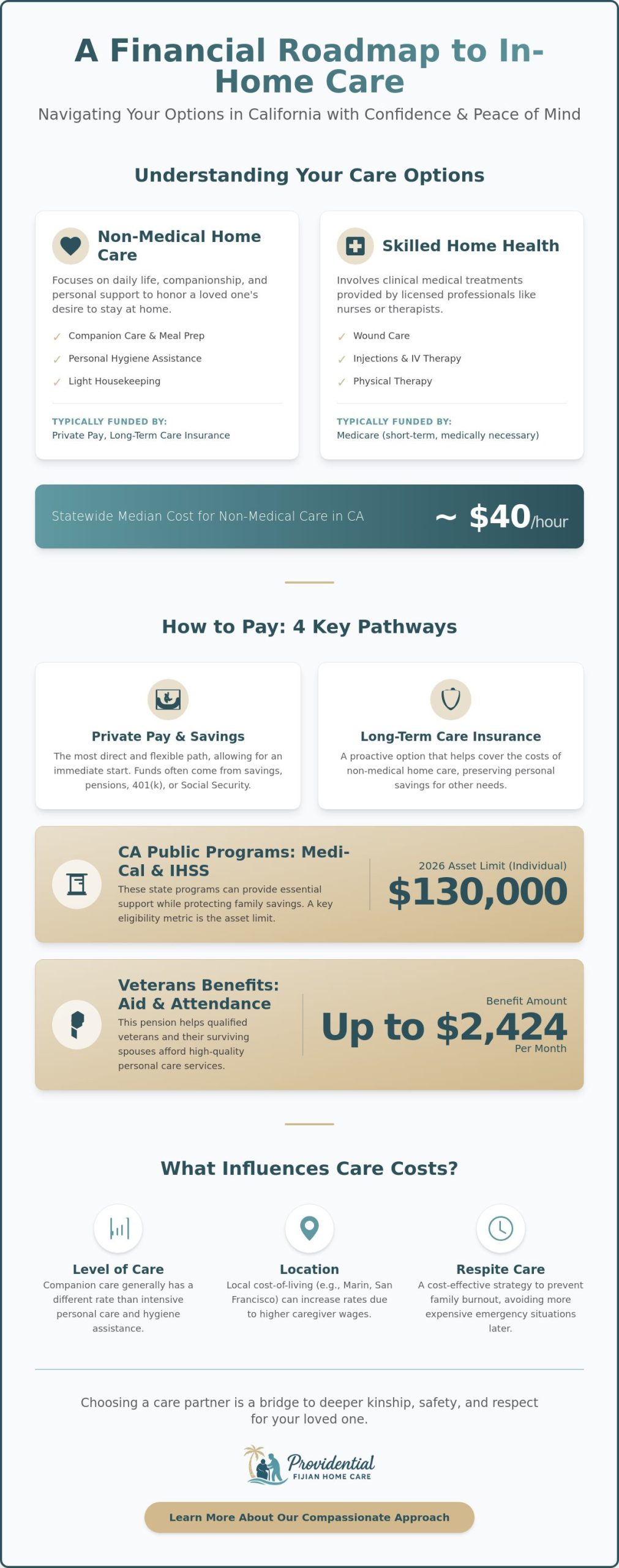
Caring for an elder at home is more than a logistical arrangement; it’s a sacred commitment to honoring their legacy and presence within the family. As you explore how to pay for in-home care in California, it’s vital to distinguish between non-medical home care and skilled nursing. Non-medical care focuses on the beautiful, everyday rhythms of life, such as companion care, meal preparation, and personal hygiene assistance. Skilled nursing, by contrast, involves clinical medical treatments provided by licensed nurses. In 2026, the statewide median cost for non-medical in-home care in California is approximately $40 per hour. While this represents a financial commitment, it’s a profound investment in your loved one’s dignity. For families managing specific conditions, such as dementia care in Sonoma County, the budget often reflects the specialized, patient attention required to maintain a safe and familiar environment.
Viewing professional care as a culturally significant investment shifts the perspective from a burden to a blessing. In many traditions, the elderly are the anchors of the domestic sphere. Providing them with high-level care is a way of returning the benevolence they showed us. When you choose to bring a supportive presence into the home, you aren’t just buying hours; you’re securing a sense of kinship and safety for someone who deserves the highest esteem.
Factors Influencing Home Care Rates in Santa Rosa and Sonoma
The cost of care isn’t a static number. It flows based on the specific needs of your family. Simple companion care or light housekeeping generally sits at a different rate than intensive personal care and hygiene assistance. Local cost-of-living adjustments in Marin and San Francisco counties often push rates higher than the state average due to the higher wages required for dedicated caregivers in those areas. Additionally, incorporating respite care into your plan is a wise, cost-effective strategy. It allows family members to rest and recharge, preventing the emotional exhaustion that often leads to more expensive, emergency care situations later on.
Home Health vs. Personal Home Care: Funding Differences
Understanding the financial landscape requires a clear look at how different services are funded. Home care in the United States is often divided into medical and non-medical categories. Medicare typically only covers “Home Health” services that are short-term and medically necessary, such as physical therapy or wound care. It rarely pays for the long-term, non-medical “Home Care” that helps a senior stay safely in their own bed. This is why private-duty care requires distinct financial strategies, like long-term care insurance or personal savings. Choosing a caregiver agency that understands these nuances helps you navigate the bureaucracy with confidence and grace.
Private Pay and Insurance: The Most Common Funding Paths
The “Private Pay” model is often the most direct path to securing the personalized, kinship-based care your elder deserves. While it can feel emotionally heavy to dip into retirement accounts or life savings, remember that these funds were built for security and comfort. Using them to fulfill a loved one’s wish to age in their own home is a profound gesture of respect. When families research how to pay for in-home care in California, they often look toward a combination of Social Security benefits, pension payouts, and 401(k) distributions. By using private funds, you gain the freedom to choose in-home help for seniors that is specifically tailored to their unique history and domestic needs.
While public resources like the In-Home Supportive Services (IHSS) program are vital for many, private pay allows for an immediate start without waiting for government assessments. This flexibility ensures your loved one receives a supportive presence exactly when they need it most. It removes the stress of navigating bureaucracy during a time when your focus should be on family connection and emotional peace.
Long-Term Care Insurance (LTCI) in California
If your family was proactive enough to secure a Long-Term Care Insurance policy years ago, now is the time to bring those benefits to light. Verifying coverage is a critical first step. You’ll want to confirm if the policy covers non-medical “custodial care” rather than just clinical nursing facilities. Be mindful of the “elimination period.” This is essentially a waiting period where you must pay out of pocket before the insurance company begins its contributions. Filing a claim early is especially important for those needing Alzheimer’s support or hospice care, as the paperwork can take time to process. Getting these details right ensures that the high level of esteem you hold for your elder is matched by the care they receive.
Leveraging Home Equity: Reverse Mortgages and Loans
For many California homeowners, the house itself is the most significant asset. A reverse mortgage allows seniors to convert a portion of their home’s equity into cash. This can then be used to fund high-quality care while they remain in their beloved residence. Alternatively, a Home Equity Line of Credit (HELOC) can be a practical bridge for short-term needs, such as post-surgical care. These financial tools are complex. Consulting a local Sonoma County financial advisor is a wise way to ensure you’re protecting the family legacy while providing for current needs. If you’re feeling overwhelmed by these choices, we invite you to reach out for a gentle conversation about how we can help your family find the right balance.
California Public Programs: Medi-Cal and IHSS
For families navigating the delicate balance of budget and benevolence, California’s public programs offer a vital sanctuary. Medi-Cal, our state’s version of Medicaid, serves as a community safety net that honors the dignity of our elders by providing the financial means for them to remain in their own homes. A common fear is that having modest savings will disqualify a loved one from help. However, as of January 1, 2026, the eligibility landscape has shifted. An individual can now qualify for full-scope Medi-Cal with up to $130,000 in countable assets, while a married couple can have up to $195,000. These changes mean that more families can access professional support without exhausting every resource they’ve worked a lifetime to build. Understanding these limits is a primary step in learning how to pay for in-home care in California while maintaining the high level of esteem your loved one deserves.
A cornerstone of this support is California’s In-Home Supportive Services (IHSS) program. This resource is specifically designed to prevent the heartache of unnecessary institutionalization. It views caregiving not as a clinical chore, but as a domestic necessity that keeps families whole. By providing funds for personal care and hygiene assistance, IHSS ensures that the domestic sphere remains a place of safety and kinship for those who have anchored our lives for decades.
How the IHSS Program Works
The journey toward IHSS support begins with a simple application to your local county social services office. This is followed by a home visit from a social worker who conducts a needs assessment to determine how many hours of help are required for safety and health. One of the most beautiful aspects of IHSS is its “Self-Directed” model. This allows the senior to hire their own caregivers, which can include family members or trusted friends. In the Bay Area, a frequent misconception is that high property values automatically disqualify you. It’s important to remember that your primary home and one vehicle are typically considered “non-countable” assets, leaving the door open for many families to receive the help they need.
Medi-Cal Waivers and Assisted Living Alternatives
Beyond IHSS, California offers Home and Community-Based Services (HCBS) waivers. These programs are designed for seniors who require a higher level of care but wish to avoid the sterile environment of a nursing home. These waivers provide a supportive presence that allows for aging in place with grace. Because IHSS hours are often limited, many families choose to combine these public benefits with supplemental home care givers. This balanced approach ensures full coverage during the most vulnerable hours of the day, creating a seamless blanket of protection and kinship for your elder. When you explore how to pay for in-home care in California, remember that these programs are here to serve as a bridge to the high-quality life your loved one earned.
Veterans Benefits: Honoring Those Who Served
Honoring those who served our nation is a core value that resonates deeply within our community. For veterans and their surviving spouses, learning how to pay for in-home care in California often leads to the discovery of the VA Aid and Attendance pension. This benefit is a tax-free addition to a veteran’s monthly pension, designed specifically to provide a supportive presence for those who require help with the daily rhythms of life. Whether it’s assistance with personal hygiene or medication reminders, this pension acts as a bridge to the high level of esteem our heroes deserve. It ensures they can remain in the comfort of their own domestic sphere, surrounded by the memories of a life well-lived.
The VA defines “clinical need” not just through medical procedures, but through the necessity of a caregiver’s help with activities of daily living. This includes non-medical personal care and hygiene assistance, which are essential for maintaining safety and dignity at home. For families exploring home care in Santa Rosa, CA, this benefit is a powerful resource that transforms professional support into an affordable reality of kinship. Navigating the application process can be complex, which is why we highly recommend working with a Veterans Service Officer (VSO) in Sonoma County. They act as loyal advocates, ensuring your family receives every measure of benevolence your loved one earned through their service.
Eligibility for the Aid and Attendance Pension
To qualify for this meaningful support, a veteran must have served at least 90 days of active duty, with at least one of those days occurring during a recognized wartime period. For the year 2026, the VA has established a net worth limit of $163,699 for eligibility. The financial support is substantial; a single veteran can receive a maximum monthly benefit of $2,424, while a surviving spouse may qualify for up to $1,558 per month. For those over the age of 65, the VA often considers the veteran “permanently and totally disabled” if they are homebound or require the regular assistance of another person to stay safe. This recognition allows families to focus on the heart of caregiving rather than the stress of the budget.
The VA Community Care Network (CCN)
Another vital avenue for support is the VA Community Care Network. Through this program, the local VA clinic in Santa Rosa can sometimes authorize the VA to pay a professional agency directly for home care services. This is especially beneficial when a veteran is transitioning from a hospital stay back to their own bed. It provides a seamless transition of care that prioritizes the veteran’s safety and emotional well-being. By leveraging the CCN, families can ensure a professional and supportive presence is waiting for their loved one the moment they return home. If your family is ready to explore how these benefits can support your loved one’s wish to age at home, contact us today for a compassionate consultation about how we can help.
The Providential Fijian Approach: Affordable Care with Kinship
At Providential Fijian Home Care, we believe that the act of caregiving is a high privilege rather than a chore. Our mission is built on a simple yet profound truth: professional care should feel like kinship. While previous sections of this guide explored the technical side of how to pay for in-home care in California, we focus on the emotional value of that investment. Our approach is rooted in a heritage of warmth and patience, where elders are revered as the heart of the domestic sphere. This cultural worldview ensures your loved one receives high-level care that is steady, welcoming, and unhurried. When a caregiver enters your home, they aren’t just a service provider; they become a supportive presence that honors your family’s history.
We work closely with families to find a balance that respects both their budget and their heart. A personalized care plan isn’t just about scheduling hours; it’s about proactive prevention. By providing consistent assistance with medication reminders, meal preparation, and personal hygiene, we help prevent the complications that often lead to hospital readmissions. Avoiding these emergency situations can save families significant money over time. Our goal is to maintain your loved one’s health in their own bed, surrounded by the safety and security of their own home. We view this work as a sacred duty, ensuring that the benevolence you show your elders is matched by the quality of care they receive.
A Support Network in Sonoma, Marin, and San Francisco
Our commitment to the community is deeply personal. We understand the domestic importance of the elderly in local areas like Petaluma, Windsor, and Healdsburg. We don’t believe in high-pressure sales tactics or corporate jargon. Instead, we invite you to a low-stakes dialogue. This is a gentle, unhurried conversation where we listen to your story and help you understand how to pay for in-home care in California using the resources available to you. Whether you’re navigating Medi-Cal asset limits or exploring VA pensions, we’re here to act as a loyal guide for your family’s journey.
Take the First Step Toward Reverent Care
To the family caregiver who feels the weight of responsibility: you don’t have to walk this path alone. It’s natural to feel a sense of stress when navigating the bureaucracy of long-term care, but seeking help is an act of deep love. We invite you to join us for a compassionate consultation to discuss your specific needs. Let’s create a roadmap together that ensures your loved one is safe, respected, and cherished. We’re a local, family-run pillar of the community, and we promise to treat your home with the same high regard we give our own. Final thoughts are simple: your family is our family.
Securing a Legacy of Care and Kinship
Navigating the financial landscape of aging in place is a journey of devotion. By exploring expanded Medi-Cal asset limits, utilizing VA Aid and Attendance benefits, or leveraging private resources, you are building a bridge to a safer future for your loved one. Understanding how to pay for in-home care in California is the first step toward reclaiming your peace of mind and ensuring your elder remains the respected heart of the home. These programs are more than just numbers; they are the tools that allow you to honor a lifetime of memories with the dignity they deserve.
Since 2016, our family-run agency has been a supportive presence in Santa Rosa and across Sonoma, Marin, and San Francisco counties. We specialize in dementia and hospice support with a kinship-first approach that treats your family as our own. You don’t have to carry the stress of these decisions alone. We invite you to begin a compassionate dialogue about your loved one’s care today. Together, we can find a path that provides the safety, benevolence, and high esteem your loved one has earned. Your commitment is an act of love, and we’re here to help you see it through.
Frequently Asked Questions
Does Medicare pay for in-home care in California?
Medicare typically does not pay for non-medical in-home care or what is often called custodial care. It’s designed to cover short-term, medically necessary “Home Health” services like physical therapy or wound care following a hospital stay. Families looking into how to pay for in-home care in California usually find that Medicare is not a long-term solution for personal care and hygiene assistance.
How much does 24/7 in-home care cost in Santa Rosa?
The cost of continuous care depends on the specific needs of the senior, but families should use the 2026 statewide median of $40 per hour as a planning benchmark. For 24/7 support, many families choose to combine professional help with respite care to manage the budget while ensuring a steady, supportive presence is always in the home. This balanced approach protects both the family’s finances and the elder’s safety.
Can I get paid by the state to care for my elderly parent in California?
Yes, you can receive payment through the In-Home Supportive Services (IHSS) program to care for your parent. This “Self-Directed” model honors the kinship between you and your loved one by allowing them to hire you as their provider. It recognizes that caregiving is a high privilege and ensures that the domestic sphere remains a place of safety and deep respect.
What is the income limit for IHSS in California 2026?
In 2026, the monthly income limit for the Aged and Disabled Federal Poverty Level program is $1,835 for an individual and $2,489 for a couple. These thresholds help determine eligibility for full-scope Medi-Cal, which is a prerequisite for receiving IHSS benefits. Staying within these limits allows families to access a community safety net that values the dignity of our elders above all else.
Is long-term care insurance worth it for home care?
Long-term care insurance is a valuable investment if the policy specifically covers non-medical assistance in the home. It provides a profound sense of security, knowing that your loved one can receive high-level care without exhausting the family’s legacy. It’s important to verify your policy’s elimination period, as this is the time you’ll pay out of pocket before the insurance begins its supportive contributions.
How do I apply for Medi-Cal for my senior parent?
You can apply for Medi-Cal online through the BenefitsCal portal or by visiting your local Sonoma County social services office. The 2026 asset limits allow an individual to have up to $130,000 in countable resources, which makes the program more accessible than in years past. Starting a low-stakes dialogue with a social worker early can help you navigate the paperwork with patience and grace.
What veterans benefits cover home care for spouses?
The VA Aid and Attendance pension offers up to $1,558 per month specifically for the surviving spouses of wartime veterans. This benefit is intended to help with the costs of non-medical personal care and hygiene assistance for those who can no longer live independently. It’s a reverent way for the nation to honor the loyalty and service of military families by providing a blanket of protection.
What happens if we can no longer afford home care?
If private funds are depleted, California offers public programs like IHSS and Medi-Cal waivers to ensure seniors aren’t forced into institutional nursing homes. We recommend exploring how to pay for in-home care in California long before a crisis occurs to ensure a smooth transition to these public resources. Our local, family-run agency is always here to help you find a path that preserves your loved one’s kinship and safety.